Showing posts with label Belgium. Show all posts

Monday, October 22, 2018

Random Things to Know about Liège, Belgium (Part II: Food Edition)


Last time I started a two-part series entitled Random Things to Know about Liège, Belgium, in which I talk about... well... random things about Liège, Belgium. This is the second part of that series, in which I'll delve into the world of Belgian food (and food typical of Liège).

So, without further ado, here we go again:


1. Fries (frites)


Frites with sauce andalouse

In case you're out of the loop, French fries are not French, they're Belgian (oh man... as a Finn and as a regular receiver of comments such as "But I thought Nokia was from Sweden," I feel your pain, Belgium). Traditionally, authentic Belgian fries are thicker than say, fast food fries, and usually double-fried. Also, they are often cooked in ox fat. 


Now, if you know this latter fact, you might have one up on a native Belgian in frite trivia, since - according to my non-exhaustive study that consisted of three whole Belgians - this information doesn't seem to be common knowledge in Belgium. However, If you've ever gone on a tourist tour in Liège, you are sure to have heard this shocking ox fat fact.

Sauces

Belgian fries are, of course, served with a sauce. Many non-Belgians are under the impression that this sauce is always mayonnaise, but that's only half the truth. Yes, mayo is on the list, but so are a gazillion other (albeit, mostly mayo-based) sauces.

An example of a sauce selection

Supermarket sauces

Not every frite stand will have the same sauces, of course, but there are a few regulars that tend to appear on every list. To help you navigate the fascinating world of sauces, I've prepared this handy chart:


2. Belgian beer


As you might know, beer is one of the culinary prides of Belgium, but what do you need to know before you pop your Belgian beer cherry? Here's my subjective list of a few facts:

1. The alcohol content in Belgian beers across the board is really high (from about 6 to 11 percent, depending on the beer). If you're a beer drinker, it's inadvisable to down this beer like apple juice (a very, very bad idea). So, keep that in mind and drink responsibly!

2. If you order a beer at a bar/restaurant, it'll come with its own special glass. Sometimes a cool glass is a good enough reason to order a beer.

Case in point: La Corne du Bois des Pendus


If you are accidentally served a wrong glass at a restaurant, this is often followed by profuse apologies from the person who made the glass faux pas and an immediate change of glasses. Now, it's important you don't make the mistake I did and suggest that perhaps you can just drink from the wrong glass. You can't, and the fact that you would even think that suggests that you don't really respect the authority of the glass. You are getting the right glass, so just deal with it.

3. If you (like me) are not big on beer in general, Belgium offers another alternative: cherry beer (also known as Kriek)! Since Kriek is not a 'real' beer in the eyes of beer purists', many people only love this gem of a drink secretly. Not me, though. I love it openly.

Pretty in pink, eh?

Although cherry beer is probably the most traditional fruity beer in Belgium, it's not the only one. Other options include (but are not limited to) raspberry beer (framboise) and peach beer (pêche). If you want to go for the ultimate weirdo beer, there's a coconut beer and a chocolate beer, for instance. So, even if you don't like traditional beer, there might still be options for you.


3. Adopt a chocolate bar (with a reduced price)


If you're an expat in Liège, somebody has undoubtedly told you, "Oh, you should totally go to the Galler (Belgian chocolate brand) outlet. It's in Liège!"

Now, before you congratulate yourself on choosing such a great living location, here's where you went wrong: when you thought you were told there's a chocolate outlet in Liège [ljɛʒ], you were actually told that there's a chocolate outlet in Liers [ljɛʁs].

Liège and Liers are, in fact, two different cities (though, technically, Liers is part of the greater Liège area). So, if you live in Liers, ding ding ding, you're in chocolate town! If you live in Liège however (a.k.a NOT chocolate town), all hope is not lost. You can take a train from Liège-Guillemins to Liers, which will take you about half an hour (plus another kilometer by foot to get to the outlet). Granted, you'll have to be a relatively serious chocolate aficionado to go through the trouble of getting there, but it's doable and, depending on your level of chocolate aficionadoness, probably worth it.

An actual photo of Heaven

As you may have guessed, at the Galler outlet you can buy chocolates that are, let's say, aesthetically challenged (but still delicious) with a reduced price. There's almost too much to choose from, but the good news is that the store offers pretty generous samples (in fact, it's easy to get your daily chocolate fix just by eating samples).

Some samples

And although the chocolates at the outlet don't necessarily conform to the norms of chocolate beauty, some of them are downright adorable:

Introducing matcha chocolate with pink freckles 😍

My fiancé and I bought 2 kilos (!) of chocolate at the outlet. My initial endearingly naive comment (as I went through my mandatory buyer's remorse phase) was, "But these things expire in a month! How will we ever eat two kilos of chocolate in a month?" Well, apparently, I had never met us. After two weeks, the chocolates were gone.


4. The classics: Liège meatballs and gaufre


Liège meatballs


Liège meatballs in all their glory

Liège meatballs are a classic Liège thing, and everybody and their mother will pester you about trying them until you finally cave (unless, of course, you don't eat meat). Basically, the dish consists of two fist-sized meatballs served with fries and some salad. Traditionally, they come with something called sauce de lapin ("rabbit sauce", except it actually has nothing to do with rabbits, so you bunny lovers needen't worry) but there's also a tomato sauce option. On the menu, the traditional meatball dish is called Boulets à la liégeoise.

Now, I've had this dish a few times already but, unfortunately, in my opinion, it doesn't quite live up to the hype. Whenever I dare tell a Belgian that, however, they let me know in no uncertain terms that I just haven't found a good boulet place yet. Yeah, nice try, Belgians, but honestly, I've begun to think that Liège meatballs are nothing but that favorite Belgian child that can do no wrong in the eyes of the Liégeois. Not that I particularly dislike this dish or anything - and to each their own of course - but in my case, the boulets have yet to make me a bouliever (see what I did there?). 

Gaufre


A traditional gaufre in all its glory

The Liège waffle a.k.a gaufre is another thing you should try if you ever come to Liège. Gaufres are sold basically everywhere, but my favorite place is Pollux at Place de la Cathédrale 2 (by the way, they're not paying me anything for mentioning them), where you can get a traditional or a chocolate-covered gaufre, or one that has sticks of chocolate inside. The latter is my favorite, but if you are one of those people that hits their sweet limit very easily, be aware that this thing is super sweet!


5. Original French tacos


To clarify: Original French tacos - or, as my Mexican fiancé calls them, the biggest insult to Mexican people since the French invasion - are not a Belgian but a French concept that has spread to several countries, including, but not limited to, Belgium. Maybe they have weaseled their way into your country, too, but me, I've only known about their existence for about a year.

Now, what are Original French tacos? For the longest time, I used to pass by a restaurant that served these mysterious creatures and ponder on this very question. Then one day, while chilling at home with my fiancé, I decided to do the unthinkable, go against my better judgment, and utter the most daring words ever uttered in a Finnish-Mexican relationship:

"Honey? Would you care to join me for a bite of... Original French tacos?"

Like any good Mexican, my fiancé reacted by going through an initial phase of shock ("I can't believe you asked me that!"), followed by a full-on rebellion ("How is this even a thing? I'll never eat that stupid stuff!") until his natural curiosity of these rivaling tacos won out and he reached the state of reluctant acceptance ("Okay, let's go."). So, on that very same day, we made our way to an OFT restaurant that had just opened in Liège.

Now, what did this trip to the twilight zone teach us? Basically, we learned that an original French taco equals fast food wrapped inside a large wheat tortilla. You get to choose a protein, a sauce and some supplements. The base of these tacos is...DUNN DUNN DUNN... fries! I learned this the hard way as I asked for a side of fries to go with my "taco" and the nice lady at the counter had a hard time getting it through to me that "there are fries inside the taco." At first I thought my French was really not as good as I had thought, but - lo and behold - when I took the first bite, there really were fries inside the tortilla. I found this utterly fascinating, whereas my fiancé found that he had just lost all faith in the inherent goodness of humankind.

There are actual fries INSIDE the tortilla!

But even though the OFTs are not particularly to my taste, their concept seems super popular. The restaurant that serves them almost always looks completely packed. So, if you think you would like something like this, go ahead and try (at your own peril). 


Closing words


Just as last time, there were some foods that didn't make the cut for the sake of brevity of the post, such as those lovely lacquemant waffles. If you'd like to read more about Belgian food (or traditional food of Liège) or if you think a crucial dish is missing from the list, please write your suggestion in the comment section.

Until then, farewell! 😊


Sunday, September 23, 2018

Random Things to Know about Liège, Belgium (Part I)


After almost three years in Liège, Belgium, our family of two is now, sadly, looking to move out of the city. Therefore, I feel that the time is upon me to impart all the insights and wisdom gained during my time here in a two-part series that I'm calling Random Things to Know about Liège, Belgium. Because, who knows, maybe one day, they will come in handy for you, too!

So, without further ado, let's get started with PART I:


Random thing 1: Get used to always being the rude one


As Liège is situated in the French-speaking part of Belgium, mostly the same politeness rules as in France apply. In translation: If you're a non-native French speaker and you, say, attend a party in Liège, it is probable that you are the rudest person in the room (unless, of course, there are other expats around, in which case you might only be the second or the third rudest).

To demonstrate what I mean, let's consider exhibit A - the closing of this (albeit, formal) e-mail that I received from a Belgian:


In other words, you might as well give up now. Whatever your reply, it will come across no better than, "K, no sweat."

But, of course, Belgians are not always that formal. For example, my Belgian source informs me that the rules of tu and vous (informal and formal "you," respectively) are more relaxed now than they were a decade or so ago. For instance, it is more common to use tu in the workplace now than ever before.

This is, of course, horrible, horrible, news. Not that I have anything against more relaxed rules per se, but it's the word "more" in "more relaxed" that scares me. What is "more," anyway - that vague devil of a word? All it does is muddy the waters, so now, instead of only having to worry about sounding like a brute (too informal) in some context, you also have to worry about sounding cold and unfriendly (too formal) in other contexts. By relaxing the rules, Belgium, you have only managed to create havoc and heartbreak everywhere.

So. When it comes to politeness, your only saving grace as an expat is that you're that "adorably oblivious foreigner," so when in doubt, play that card.


Random thing 2: Saying hello has never been more difficult


Here's a fun fact: The people of Liège say hello to strangers when they cross paths! It's amazing but true. I guess at one point, somebody bumping into their neighbor on the street just figured, hey, I have a crazy idea, let's acknowledge each other's existence, and people have been participating in this weird practice of common courtesy ever since. When you get to know the person better, however, it is normal to upgrade your relationship from the "hello" stage to the one-air-kiss-on-the-cheek stage (you can read my previous blog post about cheek kissing here).

But what does your "hello" say about you? Having observed Belgian greeting rituals for three years, I was convinced that there were differences between the words (and combinations of words) you use to say "Hello." After an interview with my Belgian source (and relying partly on my own experience), I was able to create this Belgian-flag-colored chart (see below) to help you (or confuse you) in your quest to greet a French-speaking Belgian:


In conclusion, by adding the name of the other person at the end of any greeting (for example, "Bonjour, Monsieur Gaston!" or "Salut, Pierre!"), your chances of voluntary or involuntary ass-kissery increase. However, my source (who wishes to remain nameless) would like to point out that this is just one person's view and not necessarily something that every Belgian agrees with.

Well, whether he's right or wrong, I urge you to again play the foreigner card when need be!

Random thing 3: "Burying the bone" does not mean what you think 


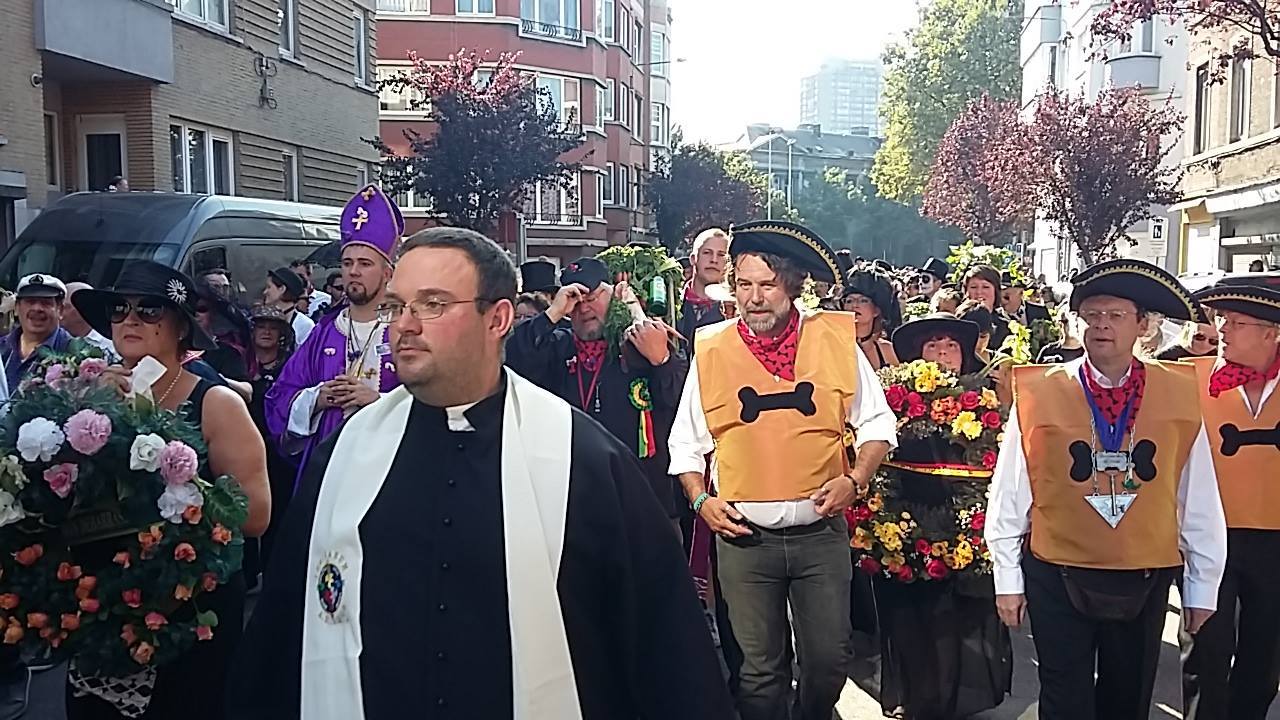
The biggest summer event in the Liège region takes place August 14-16 and brings together masses and masses of people. The party begins on the 14th with lots of concerts and street stands selling food and drink, especially shots of peket, a traditional alcoholic drink in Liège. These shots usually come in different colors and flavors (to allure innocent, unsuspecting foreigners) as in the picture below.

Violet, cuberdon (Belgian candy), and cinnamon peket

August 15 is the day of the folkloric parade, i.e. puppets (or figurines or whatever) marching down the streets of Outremeuse (there are other things, too, but the puppets are definitely the most memorable part for me). And if the concept of marching puppets isn't scary enough, picture this: these puppets are really, really tall! Like Michael Jordan on steroids tall (even though many of them do look like they peaked in high school, which lessens the scariness factor a bit.)

But neither the parade nor the previous day's shenanigans can top the brilliance that is August 16. Suffice it to say that in the contest of the most ridiculous festivals in the world, this one is right up there (and this is coming from somebody whose birth country invented the Wife-Carrying Championships).

The 16th is the day of the fake-burial of... get this... a bone (Hey, Liège! Dogs all over the world are laughing at you)! Yes, you read right. Naturally, this concept brings up tons of questions such as "Huh?", "What?", "How?" and most importantly "Why?" But lo and behold, when you ask a Belgian about the point of this tradition, each one will give you a different answer (get your stories straight, Belgians!), so over the years I've learned to ask no questions and just go with the flow.

Here's what I do know about this odd burial, however:

a) It is a good idea to dress in black. Some people go all out with their dresses, but if you don't want to see too much trouble, a black t-shirt and jeans should do the trick. Also, if you are one of those people who always wears black, let this not be the one day when you finally decide to release your inner bright-and-shiny-person and wear your sun flower shirt (this remark might or might not be directed at a certain friend).

b) This funeral is not one where people turn their noses up to alcohol - in fact, a lot of the funeral-goers seem to have turned to drinking to numb the pain of the loss of... err.... a random bone.

c) Bring celery. Or don't. But know that everybody else will be waving their celery stalk in the air, so if you aren't, for the rest of the day you'll be remembered as the one person who didn't bring celery. Can you live with that? Can you?

Just give into peer pressure - BRING CELERY!


The most serious anybody can take a fake-burial


Random thing 4: Learn to mispronounce churros or forever get the wrong pastry (at October Fair)


The October Fair (Foire d'octobre) is my very favorite thing in Liège. Now, when I say that, know that I'm part of a very small club that thinks this way. Basically, this club only consists of me and every Belgian kid under the age of 13.

The fair runs for the whole month of October and features lots of fun rides and games and other stuff you can throw your hard-earned money at (which might be the precise reason why parents everywhere hate it). (ON A SERIOUS NOTE: If you go with your kids, beware of the cars as they can appear seemingly out of nowhere!)

So far, I haven't ridden any of the rides but it is my 2-year tradition to buy a ticket to play one of those ball games where you can win a Minion. I always end up buying another ticket, because it didn't quite go right the first time, then (possibly) one more because, you know, third time's the charm, until I finally give up and buy myself a Minion at the train station.

My Minions bought at the train station


But what I love even more than the Minion game is all that junk food! Their selection includes (but is definitely not limited to) lacquemants (waffle-like creatures coated with syrup that tastes like anise), croustillons (see picture below), and churros. 

Croustillons

Now, if you're looking to buy churros, please note that you cannot pronounce the word the right way [ˈtʃur:os] but the wrong way [ʃuR'o:] to make sure you are not met with a confused "Pardon?" or - even worse - get the wrong pastry when all you had been doing for the past week was dreaming of churros with some hot chocolate sauce! You can trust me on this as I've tested this theory on a Mexican guy who eventually had to let go of his national pride and deliberately mispronounce a word of his own native tongue to cater for his fiancée's sweet tooth needs.

Random thing 5: AZERTY is an actual thing!


As somebody with a very QWERTY-centric view on life, I always thought an AZERTY keyboard was but an urban legend. That is, until I actually encountered one in its natural habitat.

AZERTY in its natural habitat

This happened at the beginning of my time in Liège when I was signing up for a gym membership and had to give my contact information to my PT. I asked to write my name on his keyboard myself rather than letting him do it, because I've learned that some letters, particularly the "extra" u in my last name (Ruuska), appear to most non-Finns either as an unnecessary decoration or a speed bump that you can well do without (FYI: You can't. The second u makes Ruuska a last name. Take that out and the actual meaning of the word changes to "Fall foliage"). My personal trainer agreed to my request, gave me the keyboard, and then was like, wow, that's a really complicated name. I took a look at the screen, and noticed that instead of Katariina Ruuska, I had written Kqtqriinq Ruuskq. So much for getting my own name right, eh?

Anyway, the moral of the story is, before you go and buy yourself a Belgian computer, make sure you get the keyboard you want and deserve.

What usually happens when I don't get to write my own name


Closing words


And there you have it! There are, of course, more random things that didn't make the cut such as the small-ass bottle you get when you order a Coke at a restaurant.

A vending machine Coke (500 ml) vs. a Coke you're usually served at a restaurant (250 ml). Now ask yourself: is this enough to quench your thirst? 


And of course, more food! But I'll talk about that more in my next blog post. Until then, friends, farewell! ☺

Sunday, May 6, 2018

Virtually Yours


From Escaping Rooms to Escaping Reality


Here's a fun fact about me: other than my loved ones, writing, occasional drawing, and food, I love love love puzzles, riddles, and mysteries. I survived my preteen years through the strength of the genius that is Agatha Christie (I was very jealous when my fiancé figured out the ending of Murder on the Orient Express less than half way into the 2017 movie, by the way), I play 2048 and do sudokus way more than I should, and these days I organize a bilingual pub quiz with two other people (a blog post coming about that soon!). I've also tried to talk my fiancé into hosting a murder mystery party at our place, but so far, he hasn't exactly given me the green light (nor a yellow light).

This is why, when I first heard about the existence of the so-called escape rooms a few years ago, I was (almost) as excited as Marvelites at the premier of Infinity War. Now, if you don't know what an escape room is, the innocent explanation, in short, is that it's a physical adventure game, where they lock you and your team of friends in a room which you need to escape within a certain time limit (normally an hour) by finding (and solving) different clues. There’s usually a theme, like a haunted house, a rescue mission, a conspiracy theory, etc. Basically, it’s a lot of padlocks, flashlights, secret rooms, codes, riddles, and all that fun geeky Sherlocky stuff.

The less innocent explanation, however, (and this is my theory) is that it's a psychological experiment. Your friends will show their true colors.


Your mind will go from paranoid...


...to insane.


In some cases, after a while in a little room with a couple more oxygen-sucking beings (a.k.a your friends), your claustrophobia will kick in.


In other cases, you'll regress to a homo not-so-sapiens sapiens, who will either figuratively or literally try to fit an obviously square peg into an obviously round hole.


After the time’s up (or after you've found your way out), you will, however, snap back to your normal self, and you and your friends can all laugh about the experience, take selfies wearing funny hats and holding magnifying glasses and fake pipes, have a drink and blame your possible failure to beat the clock on the language barrier (this one only works if you're an expat, though).

As you can imagine, I love escape rooms but, not too long ago, I heard about something even cooler - a virtual reality room! A friend of mine mentioned that she had tried that in the city of Brussels, which is only an hour of a train ride away from our current home town. Now, I had never done virtual reality before but I immediately knew for whom it would be the perfect birthday gift (in the spirit of this post, let's just say that the right answer kind of rhymes with 'Beyoncé' but is not Jay-Z). So, I asked my friend for the website and a plan started developing in my mind. 


T minus 730 hours


The website was that of Virtual Room Brussels. According to it, there'd been an unfortunate "temporal rift" in the past, which threatened to wipe out the whole human race (oops). Apparently, myself and my team were the only ones who could rescue our fellow humans by saving the so-called Alpha team, thus making us "humanity's last hope." Now, I don't know about you but I happen to take being humanity's last hope pretty seriously. Preparation was required.

I asked two of our friends, who I knew would be up to the task, if they'd be interested in celebrating my fiancé's birthday by doing VR - they were. I then sent a message to VR Brussels asking if we could do the whole humanity-saving in English since we're an international group (a Finn, a Mexican, an Argentinian, and a Chilean) - they said 'yes.'

Through this whole time I did my best to keep this experience a secret from my fiancé. For example, when writing down times and dates about the VR on my sticky notes, I used the code lautriv ytilaer in case he'd happened to have peered over my shoulder. (I mean, yes, it's an easy code to figure out but my fiancé would just have thought that I was writing something in Finnish, so it seemed like a pretty safe way to go).


T minus 48 hours


Two days before the actual date, I went to Brussels to check how to get to the right location (yes, I’m so that person). To my fiancé I told that I needed to go to Brussels for work. “I have this training thing,” I said innocently, and he didn’t ask for details, which was a bummer because I had come up with one hell of a cover story.


To be fair, my birthday-related cover stories have gotten better over the years. For example, our first year together I was planning a surprise party for my fiancé and I tried to get his friend’s contact information so that I could ask him to join. I couldn’t find said friend on Facebook so I had to make up a cover story as to why I needed my fiancé to give me this friend's number:


Me: Hey. A friend of mine is interested in going to Argentina and she has some questions. Maybe you could give me Alex’s phone number so that I can give it to her?

Fiancé: Why would Alex know anything about Argentina?

Me: Because he’s from Argentina... Right?

Fiancé: He’s from Spain.

(A pause)

Me: But he has family in Argentina?

Fiancé: Nope. As far as I know, he’s never been to Argentina in his entire life.

(A pause to quickly think of an emergency cover story)

Me: Oh, who am I trying to kid? Obviously my friend is romantically interested in Alex. But she’s too shy to say it directly. That’s why she’s really asking for his number.

Fiancé: Alex is in a relationship.

Me: Oh, for God’s sake, will you just give me that freaking number already?


T minus zero


Two days after checking out the place, I took my unsuspecting fiancé to Brussels. I only told him that I had a surprise for him, no details. My downfall, however, is that I'm completely unable to keep my cool. Even though I didn't spoil the surprise, all the way to Brussels (and maybe already two weeks prior) I kept saying stuff like, "Are you nervous? I think I would be nervous if I were you," and "Oh, I'm getting so nervous. What if this doesn't go well? What if something goes horribly wrong?" and "How are you doing? Are you getting nervous already? Don't be nervous. I know I'm nervous but you shouldn't have to be nervous, too," until by the end my poor fiancé was - yes, you guessed it - nervous. I mean, that's one way to spend your birthday, I suppose, in fear of what your crazy significant other has planned for you, but it's not necessarily the ideal way to go.


We met our friends a few minutes before the start of the experience. We were under strict instructions not to enter the building before it was time (for various reasons). None of us had ever done VR before. I cannot say much about the experience so as not to spoil it for those of you who might want to try it, but we basically had a little briefing, then each of us went to our own little black room, put on our headsets that descended from the skies (the ceiling), and suddenly, even though we were in different rooms physically, virtually, we were in the same room (this will make so much more sense when you actually experience it yourself). We were also given two controllers, which would be used to grab things in the virtual world.  

After we were all set, a guy came to close the curtain that separated my room from the corridor and was about to leave when he suddenly turned on his heels like Lieutenant Columbo and was like, “Oh, one more thing. I forgot to tell you this before, but since you guys are now wearing these headsets, your brains are connected to this machine, which means that if you die in this game, you die in real life. Oh yeah, and taking the headsets off is no longer an option. Anyway, enjoy, bye." 


Okay, no, that didn't happen, but I was kind of waiting for it to. 😉 

As I said, I cannot divulge much about the content of the experience, but I can say that, at least for me (a non-gamer), it was really cool. The graphics were realistic and I felt completely transported to the different world(s). At first, I wasn't sure I would be able to get used to the controllers, but in the end, using them was kind of instinctive. Of course, some of the skills I had in virtual reality, I totally lack in real life. I mean, if my throwing hand had been that great in high school, I wouldn't have the gym class related traumas I have today.  The only downside I can think of is that it got pretty warm in the room and especially under that headset, but it might have been because it was a very warm day in Brussels. (By the way, Virtual Room Brussels is not paying lil' ol’ me anything for this free exposure – I just really had a great time!)


Anyway, in the end, we managed to save humanity (you’re welcome). And after humanity was saved, we did the only thing that a humanity saving team in that situation would do – took a selfie.


Thank you Virtual Room for a fun experience!

Thursday, March 29, 2018

The Chocolate Showdown


When I tell people that after three years of living in Portugal - the country of sun, green wine, and beautiful beaches - I moved to Belgium - the country whose name in The Hitchhiker's Guide to the Galaxy is described as the rudest word in the whole of Universe - I always get the same reaction: Why (the hell) would you do that? people ask (and sometimes, after several consecutive months of endless rain, so do I). Well, the truth is I moved to Belgium because of love (enter The Notebook soundtrack). Yes, I know I know, I'm unoriginal, and yes, some anti-Beyoncé will one day write an anti-women's anthem about people like me, but after 2.5 years I have come to call this place home. A temporary home, maybe, but a home nonetheless. Like an inflatable mattress.

Now, these days, when people ask me, "So, what's good in Belgium?" I formulate my answer based on my 2.5 years of experience in the country. Usually, my thoughts turn to food and fictional characters: Belgium. The country of waffles and French fries (yes, French fries – poor Belgium).


The country of highly alcoholic beer (also cherry beer that even non-beer lovers like because it's nothing like beer), Tintin (that straight white guy with the cute little dog), the city of Bruges (neither food, nor a fictional character), great chocolate (great it is), and Hercule Poirot.


But let’s get back to the chocolate. For the longest time, I wanted to write a blog post about my experiences visiting different chocolate shops in Brussels, tasting and comparing the chocolates, and taking notes. Well, that blog post never happened because I just ended up buying a bunch of chocolates, eating most of them right away, taking pictures of myself holding the chocolates that had manage to escape my binge eating and that looked like each other's long lost twin brothers, and jotting down notes such as "flavorful," "crunchy," or "meh," which, despite their apparent food-writerly brilliance, would probably not have made Anthony Bourdain shake in his des(s)ert boots. But even though the blog post never happened, that experience introduced me to Belgian chocolate, and I must say that although everybody claims Belgian chocolate is great, I take a little bit of an issue with that (What? Oh, the blasphemy!). Not because the chocolate is not great (oh, phew), but rather, when is chocolate not great? Isn't it like chocolate’s inherent quality to be great? Have you ever had bad chocolate?


In my opinion, however, there’s a greater chocolate than Belgian chocolate (don't cast your stones just yet, okay?), and it was this realization that set me out on my journey to find out for once and for all which chocolate is the best. (For the record, I'm aware that, as I'm living and writing this in Belgium, these might be the very last words that I utter. But what wouldn't I do in the name of science?).


So... what can be better than Belgian chocolate?


Well, let me first tell you what it's not - it's not French chocolate, it's not Swiss chocolate, or any other chocolate that you are probably thinking of. Nor is it the OG of all chocolates. Actually, when I told my Mexican fiancé that I was writing this post, we had this delightful exchange:


Fiancé: “Do you know where the original chocolate is from?”

Me: “Let me guess… Mexico?”

Fiancé: “Mexico. Honey, I think you should-”

Me: “No.”


So, like I said, it's not Mexican chocolate either and, unfortunately (she said, not gloatingly at all), I had no access to said chocolate, so my fiancé gets to keep his illusion of the superiority of his country's pride and joy.


Anyway, the chocolate that I feel has always deserved the status of the best chocolate, the dark horse, the Rocky (but not rocky road) of all chocolates is (drumroll, please)...

FINNISH CHOCOLATE!


[Cue the crickets.]


Now, you might or might not know that I'm from Finland and you might or might not think that I’m a little biased and only claiming that Finnish chocolate is the best because in some sick and twisted way that feeds my nationalist pride. Well, rest assured that I’ve lived outside of Finland long enough not to let my judgement be (too) clouded by the big old Finnish cloud of Moomin trolls. My taste buds, however, are a different story altogether. Someone wise has said that your preferences are formed in your childhood and I don’t know for sure but I have a feeling that my taste buds are nothing but a bunch of prejudiced nationalist assholes. That’s why, in order to pass the throne of the Best Chocolate to its rightful owner, I decided to do a little test.


The Test


The crime scene: An international event in Liège, Belgium.

Testers: A crowd of people of 16 different nationalities* to ensure unbiased taste buds.

Contenders: To make this competition at least somewhat fair (to Belgium), I paired the Finnish chocolate and candy giant Fazer with two (2!) of Belgium’s chocolate brands – Galler and Côte d’Or. After the fact I heard that Côte d'Or has actually been bought by an American company, but oh well, the damage, at that point, had already been done. (By the way, none of these brands are paying me anything for this free exposure, but if they are reading this - which I'm sure they are... not -, they should obviously pay me in chocolate.)

In Finland’s corner, we’ve got these two beauties:


Fazer: Milk chocolate

Fazer: Milk chocolate with salty toffee crunch

By the way: Finns, if you’re reading this and wondering what these white stickers on the packaging are, they’re there because the chocolates were bought in Brussels at the only place that I’m aware of that sells Finnish goodies – the Finnish Seamen’s Church (Yes, ‘Seamen’. Oh, grow up, you immature person you!) – and they needed to have the product description in both French and Dutch.

In Belgium’s corner, there are these two solid options:


Galler: 'LAIT Profond' milk chocolate

Côte d'Or: 'Bloc' caramelized almonds with a pinch of salt

The two milk chocolates (Fazer and Galler) and the two ‘exotic’ milk chocolates (Fazer's salty toffee crunch and Côte d'Or's Bloc) will go head to head (by the way, I called the latter 'exotic' so as not to steer the testers' opinions in any particular way). However, it should be noted that the two exotic chocolates are unfortunately not 100 percent comparable as Côte d'Or's Bloc has almonds, whereas Fazer's version does not. Obviously, my intention was to find a salted caramel(ish) version of both the chocolates, and after four stores and an hour of chocolate tasting (I know, my life is hard), this is the closest I could get.


Test Setup


The testing day was cold and rainy (what else is new, Belgium?). At home, my fiancé helped me break the rivaling chocolates down into smaller pieces (some more cooperatively than others) and when we arrived at the testing place, we placed them in the little containers shown below. The milk chocolate (Finnish chocolate in cup A and Belgian in cup B) is on the left-hand side of the picture and the ‘exotic' milk chocolate (Finnish chocolate in container A and Belgian in container B) is on the right. The testers were asked to taste these chocolates and choose their preference (A or B). They were not told the origin of the chocolate, and even if they chose B (the Belgian option), I kept my cool and only judged them on the inside.


Curiously enough, it wasn't too hard to get people to participate in the chocolate test (I know, crazy, right?). Most were eager to participate, and in the end, thirty-six people took part in the test, out of whom one participant only tried the milk chocolates and couldn’t decide between the two options and one participant didn’t quite care for either of the exotic chocolates. The rest of the participants tried and evaluated them all.

Nationality had some effect. For example, all Italians (except for one rebel) were unanimous about the superiority of the Finnish chocolate (yay... I mean, I'm completely impartial). Also, both the Mexicans answered the same way (4 points go to... Finland!), but then again, there were only two of them. FUN FACT: Most Belgian participants preferred the Finnish option in both cases. Yeah, I mean, I know this was a blind test and all but… where is your national pride, Belgians?


So, who won?


Before the testing day, I crafted the diagram below to help me evaluate the results as fairly as possible. As you can see, there's a column for nationality, two to mark your preference, and one for any comments that the participants might have.


As it turns out, surprisingly many people used the comment section. Here are some problems that the comments highlighted:

- As explained before, the salty caramel(ish) chocolate option wasn’t identical for both countries as the Côte d’Or version had almonds. This might very well have affected the results.
- No water to cleanse the palate with. (Moreover – even though nobody mentioned it – we have to take into account the fact that the test was set up at a bar, so different drinks might have affected taste buds in different ways.)
- We had no dark chocolate, which I was told is the thing that Belgians are the most famous for.
- Belgians were our biggest group of testers, whereas there were no Finns -> potential for bias

Each selection of A or B gained one point for the corresponding chocolate. So, whenever a tester would mark A as their preference, that was one point for Finland, and whenever they marked B, Belgium gained one point. After counting all the points, these are the results I got:


Finland (A)
Belgium (B)
Milk chocolate
21
15
‘Exotic’ milk chocolate
22
11


Now, if we only look at the numbers and disregard all other factors, we have a clear winner.


But wait! Hold up!

Because of the margin of errors and the small number of participants, I wanted to make sure that the results were not just a coincidence. Since, unfortunately, I live up to the stereotype of writers not being good with numbers, I asked my fiancé, who is a physicist (ergo, good with numbers), to create the below diagram. Of which I understand nothing at all, but hey, it looks impressive!


Anyway, what my fiancé explained is that basically it is hard to rule out the possibility of a random result especially in the case of the milk chocolates (the exotic chocolates were a little bit further apart, but randomness cannot be ruled out in that case either).

So, because of the above diagram and because I simply cannot deal with a crying chocolate bar (and because this is my blog after all and not a scientific journal), I will apply the "they all lived happily ever after" approach which means that we will call it…

A TIE!


Hurrah! Long live Belgium! Long live Finland! And long live chocolate!

Closing words


Many thanks first of all to my fiancé for all his help, to everybody who so kindly volunteered to recruit participants for me when I was too shy to ask myself, and, of course, to all the testers who volunteered for this "study." I hope you had as fun as I did!


*Belgian, French, Turkish, German (and German-Kurdish), British, Argentinian, Russian, Romanian, Italian, Spanish, Greek, Mexican, Egyptian, Colombian, Lithuanian, Iranian